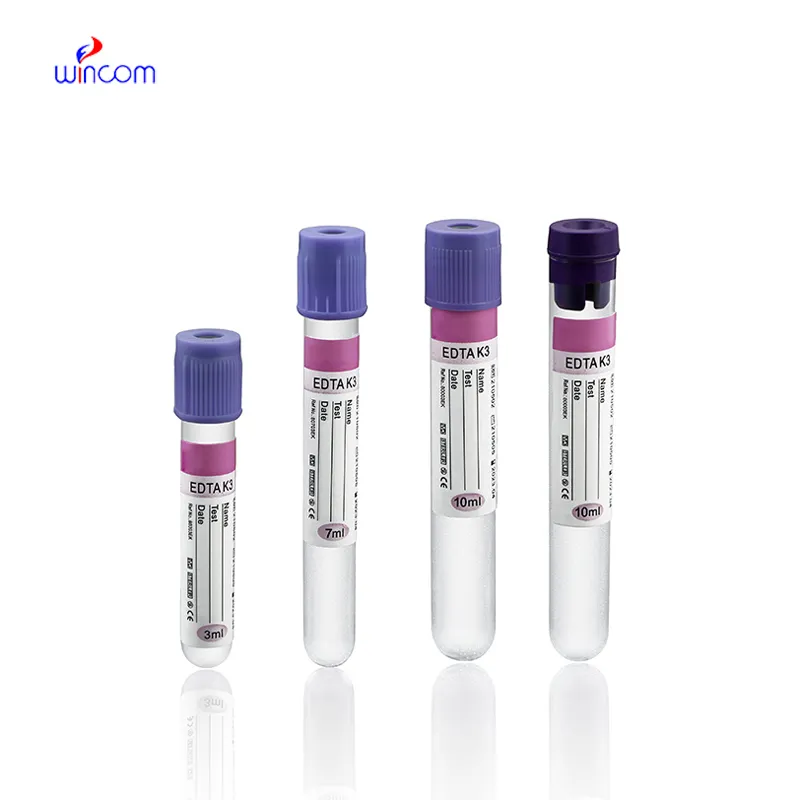
The main goal of china blood tube collection is the preservation of blood samples from the time they are collected until laboratory processing. The sterile design, secure closures, and pre-measured additives guarantee the stability of cellular and plasma components. These tubes are used by hospitals and research centers to lower contamination risks and facilitate automated testing processes. Their ability to work with centrifuges, analyzers, and barcode systems allows for quick and accurate sample tracking and processing. The color codes help the medical staff and the laboratory workers to quickly identify the type of tube. By delivering dependable performance, china blood tube collection become a crucial tool for laboratory diagnostics that are accurate, safe, and reproducible.

Blood donation and transfusion units employ china blood tube collection to gather donor samples for carrying out compatibility testing and infectious disease screening. Anticoagulant-containing tubes help keep the cells viable and avoid clotting while the samples are being kept. Laboratory workers need them for secure handling, accurate labeling, and the entire donor process being traceable. The connection of china blood tube collection with automatic analyzers permits quick testing of donor blood, therefore, patient transfusion products in the hospital are safe. Their uniform design makes the process easier, increases the quality of the samples, and decreases the number of mistakes in blood bank and transfusion operations.
In hospital research centers, china blood tube collection could change to be able to assist special tests that need very carefully preserved samples for high-level studies in genetics, proteomics, or metabolomics. In the future, the tubes might have stabilizers in them which make the very sensitive substances in the samples not to be degraded even during transport or storage. The automatic labeling and tracking systems will be the ones that guarantee sample traceability and laboratory standards compliance. Sample traceability and compliance with laboratory standards will be assured by automated labeling and tracking systems. The hospitals and laboratories will experience fewer pre-analytical mistakes and better reproducibility. The future china blood tube collection will be the main factor of precise, fast, and trustworthy clinical and research testing workflows through the combination of technology innovation, better chemical stabilization, and automated system compatibility.

china blood tube collection routine maintenance procedures are primarily concerned with handling and environmental conditions rather than mechanical maintenance. To keep the tubes sterile, laboratories must guarantee that they are not opened until they are required. The tubes should not be exposed to moisture, dust, or chemical vapors. To reduce the risk of cross-contamination, hospital personnel must strictly adhere to the established protocols for disposal after each use. Cleaning and monitoring of storage areas for temperature stability should be done regularly. By providing controlled conditions and consistently applying handling procedures, healthcare institutions will be able to maintain the dependability of china blood tube collection all through their projected usage life cycle.
china blood tube collection are typically employed for blood collection in a matter of seconds in emergency rooms and ICU. The different colors of their caps are a sign of what kind of additive is present inside, thus making it easier for the doctors to choose the right tube for tests such as coagulation, blood chemistry, or infectious disease markers, etc. Also, these tubes can be used with vacuum-based systems for blood draw, thus providing safe and efficient collection even in hard situations. The accurate labeling and proper handling of china blood tube collection greatly reduce the chance of mix-ups between samples and make it possible to trace them back, thereby supporting the timely diagnostic decisions which are very important for urgent patient care in high-pressure hospital environments.
Q: What is the purpose of Blood Collection Tubes in emergency departments? A: The main function is to facilitate quick and secure blood collection for urgent diagnostic tests. Q: Are Blood Collection Tubes suitable for infants and children? A: Absolutely, there are specialized smaller-volume tubes for both pediatric and neonate applications. Q: What is the procedure when a Blood Collection Tube gets broken? A: The broken tubes cannot be used and should be disposed of per the hospital's rules. Q: Will Blood Collection Tubes leak if there is an accident? A: Leakage during handling and transport is minimized through the secure caps that are designed for these tubes. Q: What methods do hospitals use for tracking Blood Collection Tubes? A: A number of hospitals are using either labeling or barcode systems for sample identification and traceability.
The centrifuge operates quietly and efficiently. It’s compact but surprisingly powerful, making it perfect for daily lab use.
The hospital bed is well-designed and very practical. Patients find it comfortable, and nurses appreciate how simple it is to operate.
To protect the privacy of our buyers, only public service email domains like Gmail, Yahoo, and MSN will be displayed. Additionally, only a limited portion of the inquiry content will be shown.
Hello, I’m interested in your centrifuge models for laboratory use. Could you please send me more ...
Hello, I’m interested in your water bath for laboratory applications. Can you confirm the temperat...
E-mail: [email protected]
Tel: +86-731-84176622
+86-731-84136655
Address: Rm.1507,Xinsancheng Plaza. No.58, Renmin Road(E),Changsha,Hunan,China


 EN
 af
 es
 ar
 tr
 sw
 pt
 th
 ur
 bn
 ne
 vi
 km
 lo
 de
 ru
 fi
 nl
 fa
 fr
 ko